Op shop sees increase in dumping after zero-tolerance policy introduced
• May 14, 2026
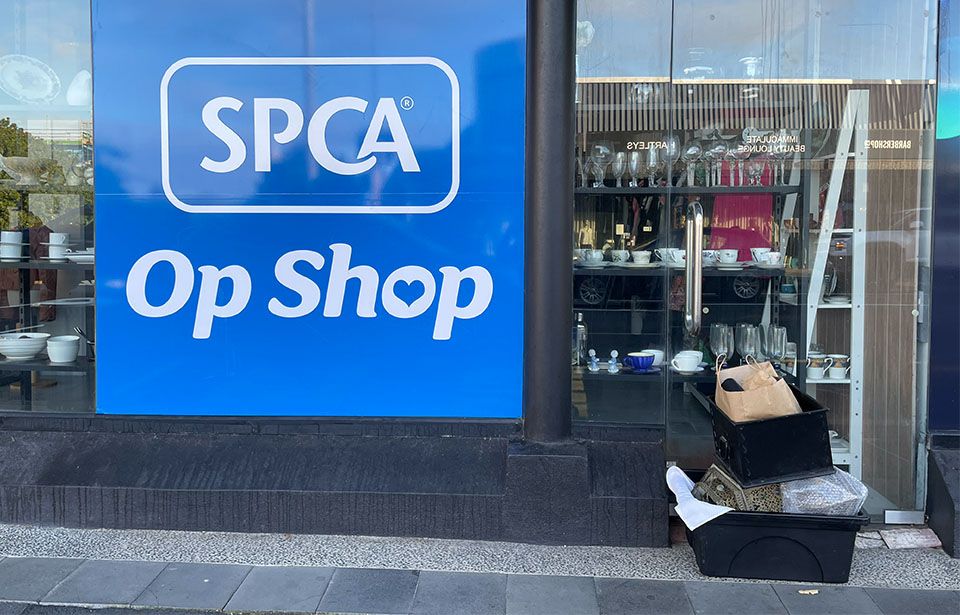
Out of hours donations are often dumped and left for Auckland op shops to deal with. Photo: Clementine McIntyre
Illegal rubbish dumping is increasing in Auckland, and while Auckland Council has launched a zero-tolerance policy, op shops are now convenient dumping spots for some people.
Leaving rubbish outside op shops has been an ongoing issue for several years, and and some shops say the new policy is not helping.
A retail assistant at Dove Hospice shop in Mount Wellington, Antonia Soan, was unaware of the council's policy, saying: "That would explain the increase of dumping that I have noticed at Dove this year.
The policy creates more pressure on people who may not have funds for rubbish removal, she says.
"I guess they get creative and dump where they can, saying to themselves, 'It's ok, I'll just 'donate' things after the donation bays have closed - that way they can’t turn my things away.'
"Which is tragic because it costs Dove Hospice so much to dispose of [it]."
She says illegal dumping is "really unfortunate".
A statement from Dove Hospice & Wellness says illegal dumping can create additional disposal and operational costs for many charity retail shops across Auckland.
"Which means money is being taken from the people who need it most," says Soan.
Auckland Council launched its zero-tolerance policy in November 2025 to deal with an increase in waste disposed of illegally .
November 2025 figures show that more than 2000 tonnes of waste are being illegally dumped annually in the city.
In the financial year ending March 2025, dumping fines issued by Auckland Council nearly doubled from the year before, rising from 309 to 599, which influenced the introduction of the zero-tolerance policy.
Auckland Council general manager of waste solutions Justine Haves says she and the council recognise the role op shops play in supporting communities.
"We understand why op shops are frustrated. When items are left outside stores after hours, even with good intentions, those 'donations' often become a burden rather than a benefit."
"Leaving goods outside op shops when they are closed has long been treated as illegal dumping, and this position has not changed with the introduction of Auckland Council’s zero‑tolerance approach last year," says Haves.
Auckland Council says it has not seen evidence that stronger enforcement has led to an increase in dumping around op shops.
"The zero‑tolerance approach is aimed at holding people accountable for repetitive and deliberate dumping," says Haves.
"Our focus is on supporting op shops by discouraging behaviour that causes them harm and by taking action against repeat or intentional offenders where evidence is available."
However, Soan says that since working for Dove Hospice's shop, she has noticed that "many people don’t have an email address or internet access, limiting access to inorganic collections".
Inorganic collections should be more easily accessible to all Aucklanders, which would then hopefully take some of the stress off the region’s op shops, she says.
For any items not up to resaleable standards, Auckland Council encourages residents to take advantage of its inorganic collection service which can be found at www.aucklandcouncil.govt.nz/whereitgoes.
--------
AI was not used in the creation of this story



Entrepreneurial platform for migrant women hopes to help change negative narratives
Keesha Levesque • June 8, 2026
Entrepreneurial platform for migrant women hopes to help change negative narratives
Keesha Levesque • June 8, 2026