Unchanged coastal plan questioned as Whangaparaoa’s cliffs continue to crumble
• April 29, 2026
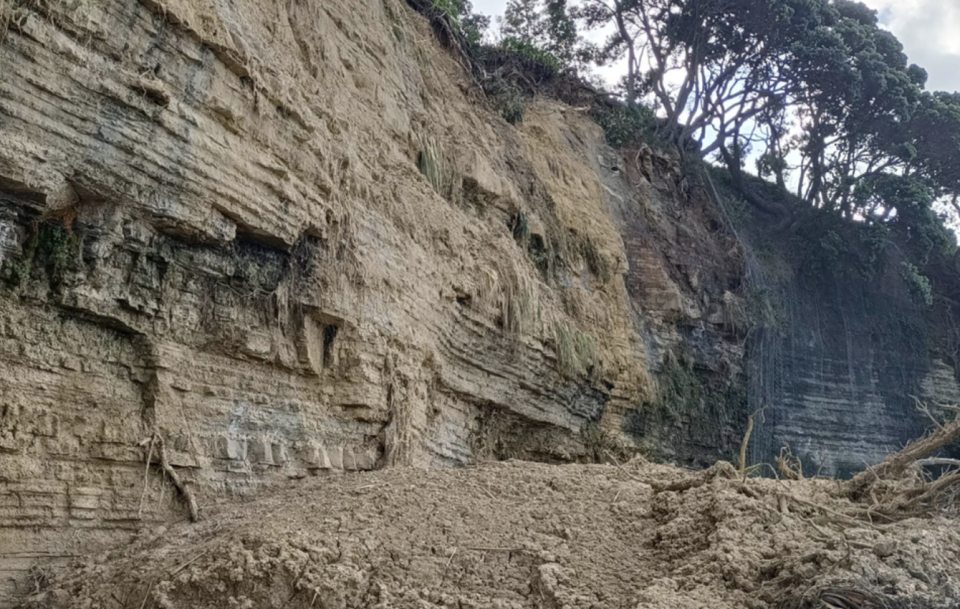
Landslip debris at the base of the eroding Whangaparāoa cliffs. Photo: John O’ Donnell
Whangaparāoa residents are worried by serious landslides repeatedly occurring across the peninsula due to widespread erosion.
In 2022, Auckland Council developed the Whangaparāoa Pilot, a shoreline adaptation plan (SAP) to explore the potential impacts of coastal erosion, rainfall flooding, and climate change in Whangaparāoa.
The plan was to focus on the needs and values of local iwi and communities in Whangaparāoa.
The coastal adaptation plan, dubbed the Whangaparāoa Pilot, was released in 2022, and has not been updated since Cyclone Gabrielle and other recent storms.
Local resident John O’Donnell has been walking the peninsula for 10 years and says trees are shifting and there are no edge protections.
"Three houses have been removed from the cliff edge at Fisherman's Cove and the slip is apparent. You can see the sediment wash all over the rockpools. You can hear the steady trickle of rock all day long."
O'Donnell notified WorkSafe on the issue in September last year.
He says the existing coastline adaptation plan is old, and it requires an immediate update.
He says the area needs warning signs for the public as well.
He said WorkSafe felt action was not needed at the time, even considering the Coastal Adaptation Plan has not been revisited.
Auckland Council chief engineer Ross Roberts says the ongoing landslides are largely driven by natural processes rather than weather events.
“With its extensive cliff coastline, Whangaparāoa is affected by coastal erosion and it’s a particularly important part of the picture when looking to understand the landscape.”
He said cliffs form through erosion, and it is a natural process that is not usually practical to prevent.
“This erosion is normally at the base of the cliff, sometimes called the ‘toe’ of the cliff, and it reduces the stability of the ground above until a landslide occurs,” he said.
Research from the council shows slope stability decreases over time as weathering and ongoing erosion gradually reduce what engineers call the factor of safety.
“Often a specific triggering event [such as a storm] will tip the landslide over from stable to unstable. However, the storm was only a minor component, it’s the coastal erosion, geology and topography that are the major controlling factors.”
The council says its response is highly site specific, balancing cost, environmental impact and long-term effectiveness.
“The actions Auckland Council chooses to take depend very much on the circumstances for each location,” Roberts said.
“We do our best to understand the risk, and how it might change in the future, so that we can make informed decisions.”
He said intervention was not always the preferred option, but the council would step in when critical infrastructure was at risk.
-----
AI was not used in the creation of this story.



Entrepreneurial platform for migrant women hopes to help change negative narratives
Keesha Levesque • June 8, 2026
Entrepreneurial platform for migrant women hopes to help change negative narratives
Keesha Levesque • June 8, 2026